

Website GEO questions users ask have become a major focus in modern search behavior, especially as AI-driven search engines and answer systems evolve.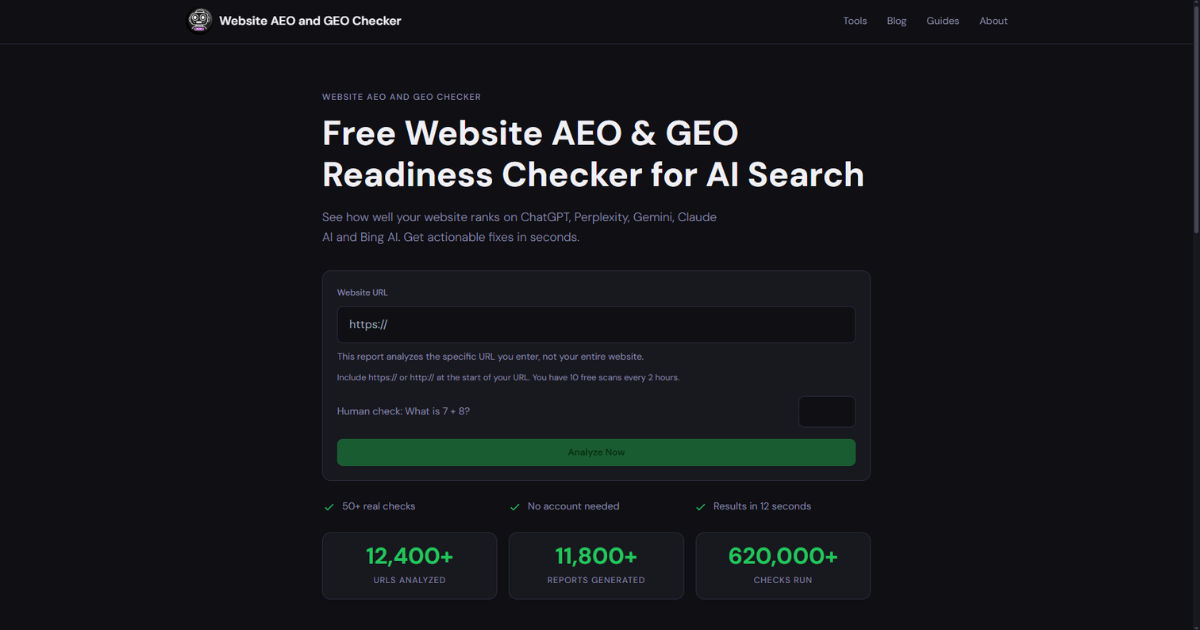
Understanding these queries is essential for content creators, marketers, and website owners who want better visibility in AI search results.
In this guide, we will also naturally include the importance of Website AEO and GEO Checker to understand how websites perform in GEO-based search environments and how user questions shape content strategy.
This comprehensive article explains what website GEO questions are, the types of questions users ask, why they matter, and how you can optimize your content for them. The language is simple, clear, and designed for a 12th-grade reading level.
What Does GEO Mean in Websites?
GEO stands for Generative Engine Optimization. It is the practice of optimizing content so that AI systems like chat-based search engines, voice assistants, and generative engines can easily understand, extract, and present your website content.
Unlike traditional SEO, which focuses on ranking in search engine results pages, GEO focuses on:
- Being selected as an AI-generated answer
- Appearing in summarized responses
- Providing direct answers to user questions
- Structuring content for machine understanding
When combined with SEO and Answer Engine Optimization (AEO), GEO ensures your content is ready for the next generation of search systems. Tools like Website AEO and GEO Checker help evaluate how well a page is optimized for these systems.
Why Website GEO Questions Matter
Users today do not just search keywords—they ask full questions. AI systems interpret these questions and extract answers from websites.
For example:
- Instead of “best laptop 2026”
- Users ask “Which laptop is best for students under budget in 2026?”
This shift makes GEO questions extremely important because:
They reflect real user intent
Users are no longer typing fragments. They are asking complete questions with context.
They guide AI-generated answers
AI search engines rely on question-based content to generate responses.
They improve content visibility
Websites that answer real questions are more likely to be selected as sources.
This is where Website AEO and GEO Checker becomes useful, as it helps identify whether your content is aligned with real user questions and AI search patterns.
What Are Website GEO Questions?
Website GEO questions are the types of queries users ask AI systems or search engines that are optimized for generative responses.
These questions usually:
- Start with who, what, where, why, how
- Require explanations or step-by-step answers
- Include context or comparisons
- Are natural language-based
Examples include:
- What is website GEO optimization?
- How does GEO help AI search ranking?
- Why is GEO important for websites?
- Which tools support GEO analysis?
These questions are the foundation of AI search visibility.
Types of Website GEO Questions Users Ask
Understanding categories of GEO questions helps you create better content. Below are the most common types.
Informational GEO Questions
These are the most common questions users ask. They are designed to learn or understand something.
Examples:
- What is GEO in SEO?
- How does generative engine optimization work?
- Why is GEO important for websites?
- What is the difference between SEO and GEO?
Purpose:
Users want knowledge, not products or services.
Content strategy:
- Provide clear definitions
- Use simple language
- Add examples
- Break concepts into steps
AI systems heavily prefer informational answers because they are easy to summarize.
Navigational GEO Questions
These questions help users find a specific website or tool.
Examples:
- What is the best GEO analysis tool?
- Where can I check website GEO performance?
- Which platform offers GEO optimization reports?
Purpose:
Users already know what they want and are looking for a platform or tool.
Content strategy:
- Mention tools and platforms clearly
- Provide direct access information
- Use structured lists
Many creators use Website AEO and GEO Checker to validate whether their content is discoverable for navigational queries.
Comparative GEO Questions
These questions compare two or more concepts, tools, or strategies.
Examples:
- What is the difference between SEO and GEO?
- GEO vs AEO: which is better?
- Is GEO more effective than traditional SEO?
Purpose:
Users want to evaluate options before deciding.
Content strategy:
- Use comparison tables
- Highlight pros and cons
- Keep explanations balanced
AI systems love structured comparisons because they are easy to summarize in responses.
Transactional GEO Questions
These questions indicate intent to take action.
Examples:
- How to improve GEO ranking for my website?
- How to optimize content for AI search?
- What tools can help with GEO optimization?
Purpose:
Users want solutions, tools, or services.
Content strategy:
- Provide step-by-step guides
- Suggest actionable strategies
- Avoid vague explanations
Using Website AEO and GEO Checker helps identify gaps in transactional readiness.
Problem-Solving GEO Questions
These are focused on solving a specific issue.
Examples:
- Why is my website not appearing in AI search results?
- How to fix low GEO visibility?
- Why is my content not picked by generative engines?
Purpose:
Users want troubleshooting help.
Content strategy:
- Identify problems clearly
- Offer fixes and steps
- Provide reasons behind issues
These questions are highly valuable because they reflect real-world user challenges.
Local GEO Questions
These are location-based queries.
Examples:
- Best SEO services near me for GEO optimization
- Which agencies handle GEO content optimization in my area?
- How does GEO ranking work for local businesses?
Purpose:
Users want local solutions or services.
Content strategy:
- Include location signals
- Provide localized examples
- Structure content for local intent
Future-Oriented GEO Questions
These questions focus on predictions or trends.
Examples:
- Will GEO replace SEO in the future?
- How will AI search change website optimization?
- What is the future of generative search engines?
Purpose:
Users want to understand trends.
Content strategy:
- Provide insights
- Discuss evolving technologies
- Avoid speculation without reasoning
How Users Form GEO Questions
Users typically form GEO questions based on:
Curiosity
They want to learn something new.
Problems
They are facing issues with visibility or ranking.
Comparison needs
They want to choose between tools or strategies.
Decision-making
They are preparing to take action.
AI-assisted behavior
As AI chat tools become common, users naturally ask full conversational questions instead of keywords.
This shift is exactly why Website AEO and GEO Checker tools are becoming important in modern digital strategy.
Why GEO Questions Are Different from SEO Keywords
Traditional SEO focused on keywords like:
- “GEO optimization”
- “AI search ranking”
But GEO focuses on:
- “How do I optimize my website for AI search engines?”
- “Why is my website not showing in AI-generated answers?”
Key differences:
- GEO uses full sentences
- GEO is conversational
- GEO focuses on intent
- GEO is AI-driven
Search engines are becoming answer engines, which makes GEO questions more important than ever.
How to Optimize for GEO Questions
To rank well in AI-driven search systems, your website must align with GEO question patterns.
1. Use question-based headings
Structure content using “What”, “Why”, “How”.
2. Provide direct answers
Avoid unnecessary filler content.
3. Use simple language
AI prefers clarity over complexity.
4. Add structured sections
Break content into clear parts.
5. Focus on intent
Understand what the user really wants.
6. Analyze performance
Use Website AEO and GEO Checker to evaluate whether your content is aligned with AI search expectations.
Role of Website AEO and GEO Checker in GEO Optimization
A major part of modern optimization is analyzing whether your website is ready for AI search engines.
A Website AEO and GEO Checker helps you:
- Measure AI readability
- Check question alignment
- Identify missing content gaps
- Evaluate answer quality
- Improve generative search visibility
It acts as a diagnostic tool for GEO readiness and helps improve content structure for AI-driven platforms.
Common Mistakes in Answering GEO Questions
Many websites fail to rank in AI search because of:
1. Keyword stuffing instead of answering
AI ignores content that is not helpful.
2. Lack of structure
Unorganized content is harder for AI to interpret.
3. Too much complexity
Overly technical language reduces clarity.
4. No question targeting
If you don’t target questions, you miss GEO traffic.
5. Ignoring user intent
Content must match what users actually want to know.
How GEO Questions Shape the Future of Search
GEO questions are transforming how people interact with search engines.
Instead of typing:
- “SEO tips”
Users now ask:
- “What are the best SEO tips for ranking on AI search engines in 2026?”
This shift means:
- Search is becoming conversational
- Answers are becoming primary results
- Websites must adapt to natural language
Tools like Website AEO and GEO Checker help ensure websites remain competitive in this evolving environment.
Conclusion
Website GEO questions are changing the way users search for information online. Instead of short keywords, users now ask full, meaningful questions that reflect intent, context, and real-world needs. These questions fall into different categories such as informational, navigational, comparative, transactional, and problem-solving queries.
Understanding these questions is essential for building content that performs well in AI-powered search engines. Websites that adapt to this shift will have a strong advantage in visibility, engagement, and authority.
Modern optimization is no longer just about traditional SEO—it is about aligning with AI-driven systems, user intent, and conversational search behavior. This is why tools like Website AEO and GEO Checker are becoming essential for analyzing and improving GEO performance.
As search technology continues to evolve, GEO questions will play an even bigger role in shaping how information is discovered, ranked, and delivered. Websites that focus on answering real user questions clearly and effectively will lead the future of digital visibility.